16 Mar 2026
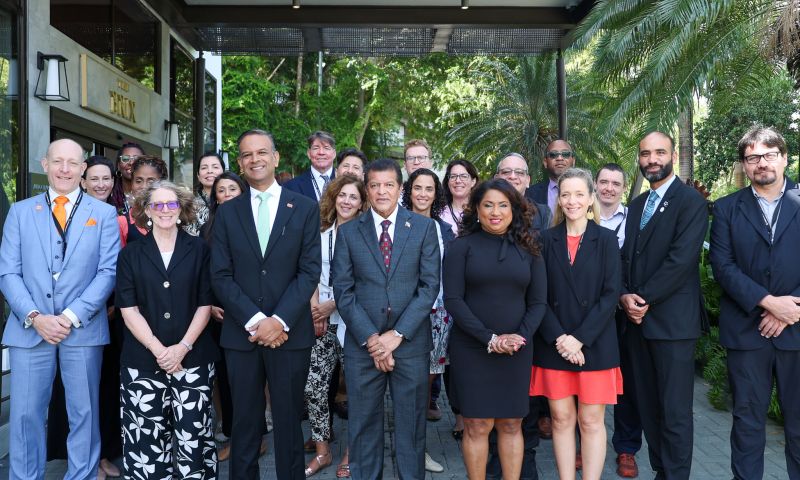
Image credit: Caribbean Public Health Agency
The UK Public Health Rapid Support Team (UK-PHRST) is proud to be contributing technical expertise to the GOARN Regional Outbreak Response Scenario Programme, launched this week in Trinidad and Tobago in partnership with the Caribbean Public Health Agency (CARPHA), the World Health Organization (WHO) and the Global Outbreak Alert and Response Network (GOARN).
Running from 16-20 March 2026, this five-day, high-intensity simulation exercise brings together 24 public health professionals from CARPHA, the Pan American Health Organization (WHO PAHO) and seven Caribbean Member States, spanning disciplines including surveillance, laboratory services, risk communication, logistics, clinical management, and infection prevention and control. UK-PHRST joins a wider GOARN global faculty team that includes technical experts from the United States and European Centres for Disease Prevention and Control (US CDC and ECDC), the University of Western Australia and Fiocruz Brazil.
The Caribbean presents a distinctive and complex epidemiological landscape. The region's many small, highly interconnected islands, porous borders, heavy dependence on tourism, and exposure to climate-related disasters create conditions in which infectious diseases can spread rapidly and across borders. Recent years have seen the region face outbreaks of measles, dengue, chikungunya, and cholera, alongside increasingly severe hurricane seasons. These realities make the case for a well-trained, coordinated, and regionally connected response workforce – which is what this programme is working to build.
This programme represents the second phase of CARPHA's collaboration with GOARN, building on a Regional Orientation Workshop held in August 2025 and supported by UK-PHRST, which brought together 34 participants to develop core deployment skills. Where that first phase focused on foundational training, this week's exercise moves into operational simulation - placing participants in a realistic, evolving outbreak scenario designed to test their capacity to respond under sustained pressure.
Ed Newman, Director of UK-PHRST, and co-Chair of the GOARN Steering Committee said, “This training brings together some of the best expertise in global public health response, and UK-PHRST is proud to support CARPHA and GOARN in delivering it. Building on the foundational work we supported with CARPHA in August 2025, we are committed to sharing technical expertise with partners across the globe to strengthen outbreak response capacity.
“This exercise demonstrates what sustained international collaboration between the experienced GOARN network partners can achieve - strengthening local, national and regional public health emergency workforces and their regional and international surge capacity.”
Initiatives like this - regionally owned, internationally supported, and grounded in realistic simulation - are the kind of sustained investment that genuinely shifts preparedness. As CARPHA Executive Director Dr. Lisa Indar noted at the Opening Ceremony, "An outbreak can arise with little warning, and the timeliness and effectiveness of our response can determine whether it remains a contained event or escalates into a public health crisis capable of overwhelming national health systems."
GOARN Manager Armand Bejtullahu echoed this, noting that the programme forms part of WHO's efforts to operationalise the Global Health Emergency Corps framework - linking national responders regionally and globally to enable faster, more coordinated responses to public health events.
The programme is funded through CARPHA's Pandemic Fund Project, with CARPHA as the Executing Agency and the Inter-American Development Bank as the Implementing Entity. It forms part of a broader initiative to reduce the public health impact of pandemics across the Caribbean through strengthened surveillance, laboratory systems, and workforce capacity.
Also By
- UK-PHRST delivers GOARN Tier 1.5 Orientation to National and International Outbreak Response Workshop to Caribbean Public Health Agency professionals
- UK-PHRST prepares deployees through new peer-learning approach and launches dedicated resource hub for shared learning
- UKHSA Conference 2025: UK-PHRST talks outbreak response sustainability alongside international partners
Please Sign in (or Register) to view further.